

Quick Answer
AI agents are now actively managing Dubai real estate projects by monitoring construction progress, predicting delays, optimizing costs, and coordinating contractors in real time. These systems reduce project overruns, cut waste, and help developers deliver on time. Dubai is one of the fastest-adopting markets for AI in construction globally, driven by government mandates and large-scale development pipelines.
Why Dubai Construction Needed a Smarter Approach
Dubai builds fast. The skyline changes in a way that few cities in the world can match. New towers, entire new districts, infrastructure projects running in parallel across the emirate. Managing all of that at speed, with tight deadlines and high standards, has always been one of the hardest operational challenges in the region. The traditional approach relied on project managers, site supervisors, manual reporting, and a lot of meetings. It worked, up to a point. But as projects grew larger and more complex, the gaps started showing. Delays were often identified too late to fix cheaply. Budget overruns became a common expectation rather than an exception. Communication between contractors, consultants, and developers was fragmented. That is the problem AI agents are now solving in Dubai real estate. Not by replacing the people who build these projects, but by giving them real-time visibility and predictive insight they never had before. According to a 2024 report by McKinsey on construction productivity, large construction projects globally run an average of 20 percent over budget and 80 percent finish behind schedule. The Dubai market, given its scale and ambition, has strong reasons to close that gap faster than almost anywhere else. This article explains how AI agents are being used across Dubai construction and real estate projects right now, what specific problems they solve, and what the results are looking like on the ground.
Section 1: What AI Agents Actually Do on a Construction Site
An AI agent in construction is not a robot on the building site. It is a software system that collects data from multiple sources, processes that data continuously, and takes or recommends actions without waiting for a human to spot the problem first. On a typical Dubai development project, AI agents are pulling information from drone surveys, site cameras, IoT sensors embedded in materials, BIM (Building Information Modeling) software, procurement systems, and weather data. The agent monitors all of that simultaneously. When something looks off, it flags it immediately. The practical difference this makes is speed of response. A human project manager reviewing a weekly report might catch a concrete pour delay on day seven. An AI agent monitoring sensor and scheduling data catches it on day one. That difference in response time, multiplied across hundreds of decisions over a project lifecycle, is where the real cost savings accumulate. Emaar Properties and DAMAC have both publicly acknowledged using AI-driven project management platforms in their development pipelines. Consultancies working in the Dubai market report that AI-assisted scheduling and risk monitoring tools are now being written into major project contracts as a standard requirement, not an optional add-on.
Section 2: The Four Areas Where AI Agents Have the Most Impact
Key Takeaways: Where AI Agents Create Value in Dubai Construction
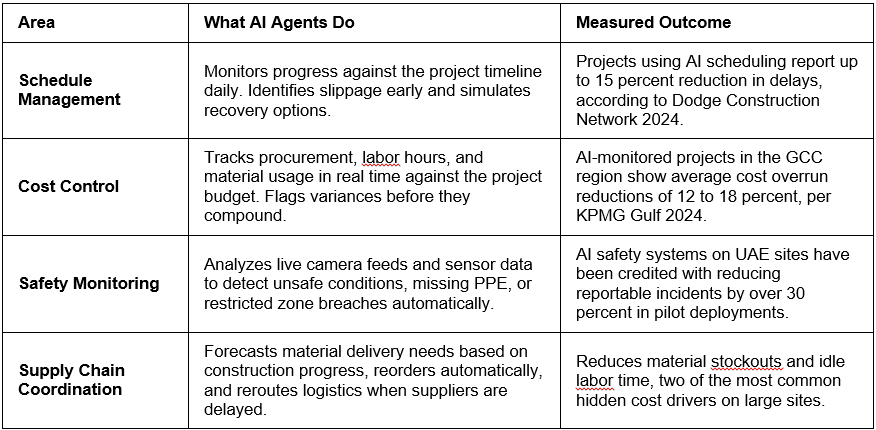
These four areas are not independent. An AI agent managing a Dubai high-rise project is often handling all of them at once, and the connections between them matter. A delay in material delivery affects the schedule. A schedule change affects labor costs. AI agents track those dependencies automatically in a way that manual project management systems simply cannot match at speed.
Section 3: How Dubai and the UAE Are Supporting This Shift
What makes Dubai particularly interesting as a market for AI in construction is not just private sector adoption. The government is actively accelerating it.
The UAE Artificial Intelligence Strategy 2031 identifies construction and real estate among the sectors where AI is expected to generate significant economic impact. The Dubai Municipality has been piloting AI-powered permit processing and construction compliance systems since 2022. The Dubai 2040 Urban Master Plan, which sets out development goals for the next two decades, explicitly requires data-driven project management approaches across all major government-linked developments. This policy environment matters because it changes the incentive structure for developers. In many markets, adopting AI in construction is a competitive advantage. In Dubai, for large projects, it is increasingly becoming a baseline expectation. Consultancies, contractors, and developers who cannot demonstrate AI-enabled project monitoring are starting to find themselves at a disadvantage when bidding for major work. The Real Estate Regulatory Authority, known as RERA, has also begun incorporating data transparency requirements that make AI-driven reporting tools more valuable. When regulators want real-time data on project progress as a condition of off-plan sales, AI monitoring systems shift from being a nice-to-have to a operational necessity.
Section 4: The Challenges That Still Need to Be Solved
The picture is not entirely positive. AI in Dubai construction is making genuine progress, but several friction points remain.
Data quality is the foundation everything else depends on
AI agents are only as good as the data they receive. On sites where sensors are poorly maintained, BIM models are out of date, or contractors are not consistently logging progress, the agent works with incomplete information. The output degrades. Teams in the UAE construction sector consistently cite data discipline across subcontractors as the hardest integration challenge.
Legacy systems do not integrate easily
Many construction companies in Dubai still run project management on systems that were not designed to share data with AI platforms. Integration work is expensive and time-consuming. Smaller contractors especially are often locked out of the benefits because the cost of connecting their systems to an AI platform exceeds what they can justify on a single project.
Skills gaps at the site management level
Site managers and project directors need to be able to interpret AI outputs and act on them confidently. That requires training that the industry has not yet caught up to at scale. A 2024 survey by CIOB across GCC construction professionals found that fewer than 35 percent felt adequately trained to work with AI project management tools. That gap is where a lot of potential value is currently being left unrealized.
Section 5: What Developers and Project Teams Should Do Next
For real estate developers, contractors, and project managers working in the Dubai market, here is a practical set of starting points based on what is actually working in the market right now.
- Start with scheduling and cost monitoring before anything else. These are the areas with the clearest ROI and the most mature tools available. Getting an AI agent connected to your project schedule and procurement data produces visible results within the first month of use.
- Audit your data infrastructure before selecting a platform. The most common failure mode in AI construction adoption is choosing a sophisticated tool and then discovering the underlying data is not clean enough to use. Fix the data pipeline first.
- Require subcontractors to use compatible reporting tools contractually. An AI agent monitoring a main contractor is limited if subcontractors are reporting manually on separate systems. Build data integration requirements into subcontract agreements from the start.
- Invest in training for project directors and site managers alongside the technology. The tool is only as effective as the person interpreting its outputs. Training is not optional; it is part of the implementation cost.
- Use the Dubai Smart City ecosystem for support. Dubai has government programs, free zone incentives, and accelerators specifically designed to help real estate and construction companies adopt AI tools. Teams that are not aware of these resources are leaving support on the table.
The Final Answer: AI Agents Are Not the Future of Dubai Construction. They Are the Present.
The shift is already underway. On the largest and most visible development projects in Dubai, AI agents are doing work that would have required entire teams of planners, analysts, and coordinators just five years ago. They are catching delays before they become crises. They are keeping budgets closer to their original numbers. They are making construction sites safer. The pace of adoption is accelerating because the business case is clear and the government is actively creating conditions that reward it. For developers still relying entirely on traditional project management methods, the competitive gap is widening with every project cycle. The question for most organizations in the Dubai market is no longer whether to adopt AI in construction management. It is how quickly they can do it without disrupting operations. Smart construction in Dubai is not a trend. It is an infrastructure decision that the market has already started making, and the projects being built today are the evidence.
Your Next Step
If your team is managing real estate development projects in Dubai, the most practical starting point is a data audit. Map out where project data currently lives, how it is collected, and whether it can be accessed in real time. That single exercise will tell you more about your AI readiness than any platform demo or vendor presentation. Start there, and the right tool selection becomes a much simpler decision.
