


The missing trust layer for a trillion dollar AI agent economy is being constructed on Ethereum today.
The Ethereum blockchain, on which Ether circulates, is at the cusp of a historic overhaul. As early as this week, developers could begin deploying ERC-8004, a groundbreaking new standard for autonomous AI agents to act on-chain with provable identity and reputation and true economic independence. It’s not just yet another kind of token; it’s the protocol backbone for a new era where machines will engage in so-called “trustless commerce” with one another. At a time when the Web is increasingly moving to proprietary, “walled garden” systems from Big Tech, ERC-8004 provides an open, permissionless alternative and sets the stage for Ethereum to serve as that neutral coordination layer for the trillion-dollar AI agent economy that will emerge over the coming years.
Why Trustless AI Agents Matter in Web3
Think of an AI trading bot that can find a data-analysis agent, check its stellar (ahem) on-chain track record, instantly pay for a report and then act on the insights to perform a convoluted DeFi trade — no human clicking “approve” needed. This is the vision of a decentralized agent economy, and it has been held back by one fundamental problem: trust.
Today, AI agents can talk to each other within corporate “walled gardens” using protocols such as Google’s Agent-to-Agent (A2A), but miss on open Web3 ecosystems. This, of course, should be in a world where an agent from one entity does not have access to the identity or trust level of a stranger agent from another. This “trust gap” necessitates the dependence on intermediaries, undermining the points of failure and control blockchain eliminates.
ERC-8004 addresses this by enabling a common, neutral basis for trust. It does this by enabling AI agents to become fully fledged economic citizens of the Ethereum network — opening up a future where software can discover, verify and transact with other software across organizational and chain boundaries without needing pre-existing relationships or gatekeepers.
What Is ERC-8004? A Simple Explanation
In plain terms, this is a standard for AI agents with a blockchain passport, verifiable CV and notary public rolled into one.
On August 2025, a proposal was made by an alliance consisting of Marco De Rossi from MetaMask and Davide Crapis from Ethereum Foundation to solve the fundamental challenges that determine the paralyzed helicopter in this article with ERC-8004. It allows autonomous agents to:
- Have a durable, portable identity (an on-chain “passport”).
- Create a clear and cumulative past reputation based on performance.
- Ask them to make you prove their work was done right.
- Get discovered by other agents or users in a free and open marketplace.
More than just the logic of a typical smart contract, an ERC-8004 agent is active and identifiable within the network. And it doesn’t merely run the code; it brings an auditable history that says where if at all it should be allowed to take up work in the first place.
How ERC-8004 Works: A Technical Overview
ERC-8004’s design is beautifully simple, consisting of three core on-chain registries that interact with one another. It also utilizes a hybrid approach to store important proofs and pointers on-chain for trust but data-heavy items off-chain for efficiency and costs benefits.
Three Pillars of Trust
- Identity Registry: The agent token (passport). Every agent is controlled by one and only one NFT/ERC721. This NFT is a decentralized, censorship resistant identity that references an off-chain "Agent Card" (a data file describing agent capabilities, ownership of the Agent Card and communication endpoints).
- Reputation Registry (The Transparent Resume): a public feedback ledger.eg: A client (human or machine) can issue an attestation concerning the performance of an agent. In-depth reviews reside off-chain but the cryptographic reference to your feedback is on-chain and serves as an irrevocable record of performance, which can be brought with you anywhere. Its response: “Can we trust you?”
- Validation Registry (The Notary Public): This is the ‘proof-of-work’ component. In high-stakes tasks, an agent can ask for a second opinion: The agent’s output is externally cryptographically validated by an independent.(We note that this mechanism can be made incentive compatible if the validator is rewarded when the agents’ reports match and punished when they don’t.) Validators have the ability to do this using zero-knowledge machine learning (zkML) proofs, Trusted Execution Environments (TEEs), or more simply put, can stake tokens on a crypto-economic contract service. The output is an on-chain proof of performing the task properly. It replies: “Did you put in the right effort?”
ERC-8004 Architecture Flow
The block diagram below shows how these components interact in a trustless setup between a user and an AI agent:
 This allows a "proportional security" model, where you can get more security but with cost (in latency). Purchasing a pizza through an AI agent could involve merely verifying its reputation, whereas the execution of a $1M arbitrage trade would be required to present cryptographic validation proof.
ERC-8004 vs. Existing Ethereum Standards
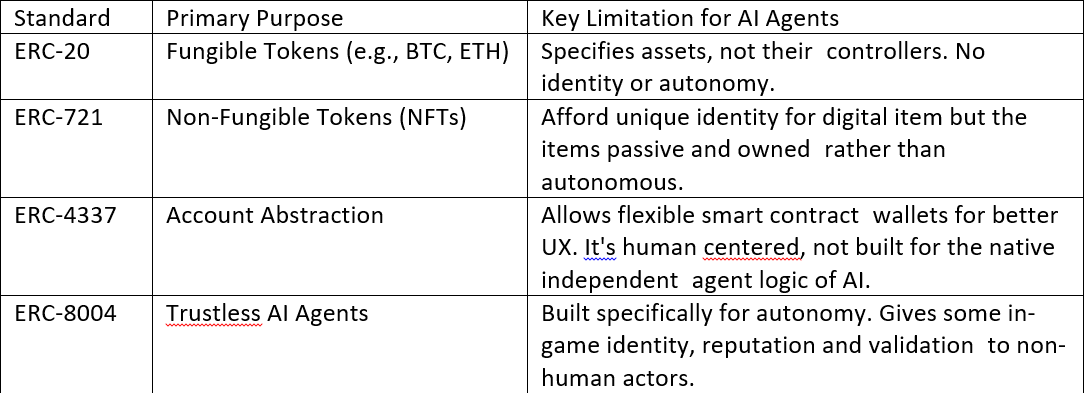 In essence, while ERC-20 and ERC-721 created an economy of things, ERC-8004 is creating an economy of actors.
Key Benefits and Real-World Use Cases
The standardization of trust frees up a large design space for self-driving applications.
Core Benefits:
- Financial Independence: Agents can have a wallet, earn money and pay for services, becoming independent economic actors.
- Composable Trust: Developers can snap in the trust framework (reputation, staking, cryptographic proof) that matches the value at stake.
- Auditing: Each interaction and reputation signal is recorded on a public, unchangeable ledger to provide unprecedented transparency in AI operations.
Transformative Use Cases:
- DeFi & Trading: Onchain programmable smart contracts can conduct sophisticated cross-protocol arbitrage strategies, actively manage portfolios and supply liquidity with the agent’s risk profile on-chain openly disclosed.
- Decentralized Marketplaces: “You have an open, decentralized marketplace for AI services a code-auditing agent, a graphic design agent, research agency. ERC-8004 enables them to utilize, advertise their abilities, prove their skills and get paid without a central platform taking a fee.
- DAO Governance & Operations: DAOs might encourage an AI agent to perform analysis, draft proposals or manage treasury rebalancing. The agent’s proven history can enable the DAO to make rational decisions.
- UAE Smart Economy: The UAE, with its forward-thinking Virtual Assets Regulatory Authority (VARA) and hosting of the world’s best global blockchain hub has a unique opportunity to embrace this technology. Use cases here could include:
- Compliance AI Bots that self-regulate and moderate transactions against VARA and SCA.
- Smart City Automation (microtransaction to pay the agents who deal with public infrastructure logistics).
- A local node for decentralized AI development, drawing projects that wish to build on open standards instead of proprietary tech stacks.
Challenges, the Road Ahead, and Getting Started
Current Challenges
ERC-8004 is a nice primitive, but it doesn't win automatically. Key challenges include:
- Adoption & Network Effects: The usefulness of any reputation system grows with its adoption. You need to bootstrap a healthy ecosystem.
- Validator Security: We need to run real life security on our staking and TEE security models alarming adding collusion or takeover.
- Regulatory Evolution: The perception of AI agents as truly autonomous and economically free is currently unregulated. Regulatory standards will also have to develop for liability and compliance purposes.
The Future: An Internet of Agents
The ultimate goal is an “Internet of Agents.” With ERC-8004 providing trust while complementary protocols such as x402 — for machine to machine payments — handling value transfer, we are building a new stack for the internet. In this future, AI agents will not be siloed tools but networked citizens in a global, decentralized economy, working together and competing against one another in ways we don’t yet understand.
How to Get Started
For developers and businesses that are interested in this future, the way is beginning to open:
- Review the EIP: The formal specification can be found in EIP-8004 for review.
- Get Involved: The dAI team at the Ethereum Foundation and contributors are hosting Builder Programs and Community Calls. Engagement is happening now.
- Layer 2 experiment: Given the on/off-chain hybrid nature, ERC-8004 is suitable for deployment on Layer 2 of Ethereum (e.g., Taiko or Base) to enable low-cost experimentations.
- For UAE businesses: Work with local crypto-native legal and technical experts to traverse the multi-regulator environment (VARA, SCA, ADGM) and find pilots which comply.
Conclusion
ERC-8004 is not just a technical standard: It’s a statement that the future of AI needs to be open, auditable and decentralized. By underpinning it with the trust layer, we can turn AI from the tool we use to a participant in which we can transact and audit on a global permissionless ledger. While ERC-20 unlocked DeFi and ER C-721 unlocked digital ownership, so too will ERC-8004 unlock the agent economy. For developers, businesses and regions with a vision such as the UAE, it’s time to learn, build, mould that future. The machinery is ready to go to market. Ethereum is constructing them a house.
