

Imagine you're trying to read a single news article online. You click the link, and instead of reading, you hit a paywall asking you to sign up for a $15 monthly subscription just to read one story. Frustrating, right?
Now imagine a different experience. You click the link, and in the background, your digital wallet automatically pays 10 cents. The article opens instantly. No forms. No passwords. No monthly commitment.
This is the promise of x402, a new protocol that's being called the "vending machine for the internet" . Just like a vending machine gives you a snack the moment you insert exact change, x402 lets websites and AI services charge tiny amounts for instant access, with zero friction.
In this guide, we will explain x402, how it works, why the future of the internet relies on it and what it means for regular people like yourself.
What Exactly Is x402?
x402 is an open payment protocol enabling websites, apps, and AI agents to receive instantaneous digital payments natively via HTTP. It was built by Coinbase and debuted with support from major tech companies including Cloudflare, Google and Visa. It’s named after the HTTP 402 status code. Back in the early 1990s, when the foundations of the web were being built, engineers reserved status code 402 to mean "Payment Required." They knew that someday, the internet would need a built-in way to handle payments. For over 30 years, that code sat dormant, until now .
x402 brings that reserved code to life. It creates a standardized way for servers to request payment and for clients to send it, all within the normal flow of browsing the web .
Think of it this way:
- HTTP 200 means "OK" (your request worked)
- HTTP 404 means "Not Found" (the page doesn't exist)
- HTTP 402 now means "Payment Required" (pay to access this content)
The Problem x402 Solves
Today's internet runs on two main business models: ads and subscriptions. Both have serious drawbacks.
The Subscription Fatigue Problem
We've all experienced it. You need access to one article, one API call, or one piece of content, but the only option is a $10–$20 monthly subscription. So you either pay for something you barely use or you walk away .
The Micropayment Problem
Traditional payment systems like credit cards charge fixed fees, often 30 cents plus a percentage of the transaction. If you want to charge 10 cents for an article, the fees eat up most of your revenue. This makes micropayments economically impossible with traditional rails .
The AI Problem
Here's a futuristic twist: AI agents are going to browse the web on our behalf. Your personal AI assistant might need to access 50 different paid data sources to research a topic for you. But today's payment systems require human sign-ups, passwords, and manual approvals. AI agents can't do that.
x402 solves all three problems at once.
How x402 Works: A Simple Walkthrough
The beauty of x402 is its simplicity. Now, let’s run through what happens when you (or an AI agent) try to access content protected by x402.
Step 1: The Request
You (or your AI agent) make a normal HTTP request against a website or API, asking to receive from the resource, say, some research paper or cluster of data.
Step 2: The 402 Response
If the resource needs payment, the server sends an HTTP status code 402 and shows details on how to pay in response headers. These instructions tell you:
- How much to pay (e.g., $0.05)
- Payment destination (wallet address)
- Choosing a blockchain network (Base, Solana etc.)
- You are up to date from data (October 2023).
Step 3: The Payment
Your digital wallet (or your AI agent’s wallet) processes these instructions, signs a transaction and sends the payment. It happens in the background, automatically — no credit card numbers or accounts to fumble with.
Behind the scenes, the system uses something called ERC-3009, a standard that allows "gasless" transactions. This means the user doesn't need to hold the native blockchain token (like ETH) to pay fees, they just pay with stablecoins like USDC .
Step 4: Verification
A special service called a Facilitator verifies that the payment was sent correctly. The facilitator checks the blockchain to confirm the transaction and then tells the server everything is valid .
Facilitators are a key innovation, they handle all the complex blockchain verification so that websites don't need to run their own blockchain infrastructure. Coinbase offers a hosted facilitator service that processes millions of transactions .
Step 5: Access Granted
Once payment is verified, the server delivers the requested content with a standard HTTP 200 OK response. The whole process takes seconds .
Here's the magic: payment becomes authentication. If you can pay, you can access. No accounts, no passwords, no personal information required .
Why It's Called a "Vending Machine for the Internet"
The vending machine analogy comes from the Federal Reserve Bank of Atlanta, and it's perfect .
Think about how a vending machine works:
- You see an item you want
- You insert exact change
- The machine instantly delivers your item
- No small talk, no membership card, no monthly snack subscription
x402 does the same thing for digital content. Websites become vending machines. You pay a tiny amount, you get instant access. No subscriptions, no forms, no friction .
The Technology Behind the Magic
While x402 feels simple to users, there's sophisticated technology powering it.
Blockchain Agnostic Design
x402 doesn't care which blockchain you use. It currently supports Base, Solana, Ethereum, Polygon, and many other networks . The protocol uses industry-standard identifiers called CAIP-2 to specify which network a payment belongs to .
Stablecoin Native
Most x402 payments use USDC, a stablecoin that maintains a 1:1 value with the US dollar. This means no price volatility, 10 cents today is still 10 cents tomorrow .
Smart Contract Innovation
For EVM chains (like Ethereum and Base), x402 uses EIP-3009 (TransferWithAuthorization). This lets users sign a message off-chain, and anyone can submit it on-chain. This enables the gasless experience where users don't need native tokens .
Multiple Payment Schemes
The protocol is extensible with different payment "schemes." The current scheme is called exact, where you pay a fixed amount for a fixed resource. Future schemes could include upto, where you authorize spending up to a limit based on resources consumed (like paying for exactly how many AI tokens you generate) .
Who's Building x402?
One of the most impressive aspects of x402 is the ecosystem behind it. This isn't some niche crypto experiment, it's supported by big tech.
The x402 Foundation
The x402 Foundation was formed by Coinbase and Cloudflare to govern the protocol and incentivize adoption v. About Cloudflare In addition to their protocol, Cloudflare already has its own global network of servers in over 120 countries that can make sure the protocol itself works at web scale.
Major Partners
Google has incorporated x402 into its Agent Payments Protocol (AP2) and A2A framework
- Visa is exploring integrations through its Visa TAP program
- Stripe is participating through its ACP (Advanced Credit Payments) infrastructure
- AWS, Google Cloud, and Anthropic are all part of the ecosystem
Adoption Numbers
As of early 2026, the x402 ecosystem has processed:
- Over 75 million transactions across multiple blockchain networks
- More than $24 million in transaction volume
- Daily transaction counts showing clear upward trends
Real-World Use Cases
x402 isn't theoretical, it's already being used in production. Here are some of the coolest uses.
AI Agents Paying for Data
This is the killer use case. AI agents can now independently purchase premium data sources, specialized compute resources, or expert knowledge bases. For example:
- An AI Research Assistant costs $0.03 per research paper it accesses
- A trading agent incurs real-time data fees per API call
- An image generation agent pays for images in real time.
Pay-Per-Use APIs
Individual requests made to an API can be sold to developers. So simple that they remove subscription tiers and API key management, just add x402 middleware. Every API call becomes a microtransaction .
Content Creator Monetization
Writers, artists, and musicians can charge tiny amounts for individual pieces of content:
- $0.10 to stream a new song
- $0.25 for an in-depth investigative article
- $1.00 to download a high-resolution artwork
This opens new revenue streams while giving consumers more choice. No more paying $15/month for a publication when you only read one article.
Cloud Storage Without Accounts
Imagine sharing files with a simple payment-protected URL. Anyone with the URL can access your files by paying a small fee, perfect for selling digital products or creating temporary storage solutions .
DeFi and Gaming
DeFi protocols can charge per query for high-frequency data. Games can allow NPCs to purchase in-game services from other players programmatically .
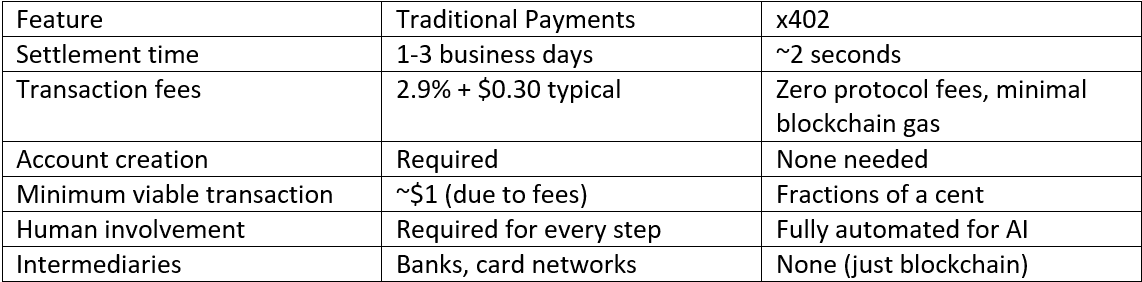
What Makes x402 Different from Traditional Payments?
Challenges and Considerations
Every technology has its quirks to work out, and x402 is no different.
Refund Limitations
One of the challenges is that blockchain transactions are typically irreversible. And Coinbase has built escrow mechanisms that allow refunds within windows of time, but it's not as open ended as credit card chargebacks."
Adoption Requires Both Sides
Buying and selling require payment protocols. While adoption is growing fast (15+ million transactions), it's still early .
AI Reliability
Some critics point out that while AI agents paying autonomously sounds great, long automated workflows can be unreliable. Humans may still need to oversee high-value transactions .
Network Reliability
Traditional payment systems have sophisticated retry mechanisms and callback handling. The x402 ecosystem is still building out these reliability features .
Privacy and Compliance
As autonomous agents transact, regulators will need to address questions about security, trust, and compliance. Projects like AnChain.AI are building compliance layers for AML and sanctions screening.
The Future: An Internet Where AI Can Spend
x402 represents a fundamental shift in how we think about online transactions.
Today, the internet's primary action is search. We look for information, and it's mostly free (funded by ads).
Tomorrow, as AI agents become our primary interface to the web, the primary action may become pay. Agents will need to compensate content creators, data providers, and service operators automatically .
This machine-to-machine economy requires payment infrastructure designed for machines, not humans. x402 provides exactly that.
The Vision
Your personal AI assistant researches sleep science by paying 50 different data sources $0.01 each, compiling insights while you sleep
Small creators earn micropayments from AI agents that use their content APIs monetize naturally without complex billing systems The internet becomes a true economy where value flows as freely as information
Getting Started with x402
If you're a developer interested in trying x402, here's how to begin:
- Check out the SDKs: x402 has SDKs for TypeScript, Python, Go, and Java
- Explore the examples: The GitHub repository includes examples for Express, Hono, Next.js, and more
- Use Coinbase's facilitator: Get started with 1,000 free transactions per month
- Join the community: The x402 Discord server has an active developer community
For regular users, you'll start encountering x402-powered services through:
- Websites offering pay-per-article options
- AI tools that pay for premium data on your behalf
- APIs that charge per call without requiring accounts
Conclusion: The Vending Machine Economy Is Coming
x402 takes a 30-year-old placeholder in the HTTP specification and transforms it into a powerful engine for the modern web. By enabling instant, feeless, frictionless micropayments, it solves problems that have plagued digital commerce since the internet's early days.
For users, it means no more subscription fatigue. Pay for exactly what you use, when you use it. No forms, no passwords, no personal information required.
For creators and developers, it means new monetization models. Charge per article, per API call, per data point, without complex billing integrations or high fees eating your revenue.
And for AI, it means true autonomy. AI agents can finally participate in the digital economy independently, paying for the resources they need to serve you better.
The vending machine for the internet is here. Insert payment. Get content. No questions asked.
